
Almond Fall Nails bring together soft autumn details, rich patterns, and artistic accents in ways that feel distinctly personal. From watercolor artwork and ember-like aura effects to chocolate swirls, leafy outlines, and delicate French tips, this collection explores 30 different directions without making every manicure feel alike. Each idea has its own visual language, whether the interest comes from fine lines, layered color placement, negative space, texture, or metallic detail. Browse the collection with an eye for the elements that catch your attention, then let those details guide the manicure that feels most like you.
1. Autumn Watercolor Nails
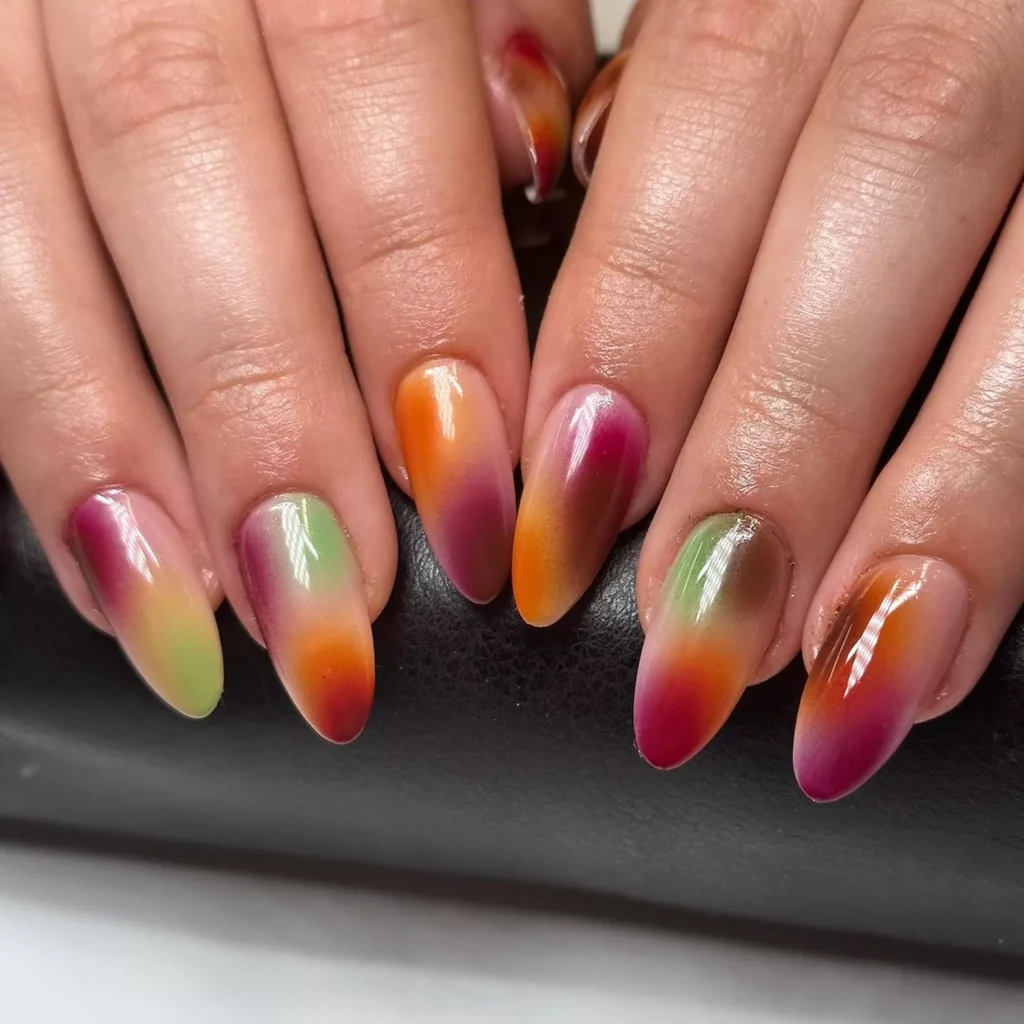
Autumn Watercolor Nails translate seasonal artwork into soft, fluid color movement across the nails. Wispy pigment shifts can sit beside one another like translucent brushstrokes, allowing individual shades to remain visible rather than merging into one flat field. Fine edges give the watercolor effect its hand-painted character, while lighter areas preserve breathing room between richer washes. Gentle overlaps add visual depth without turning the artwork into a heavy pattern.
2. Autumn Ember Aura Nails
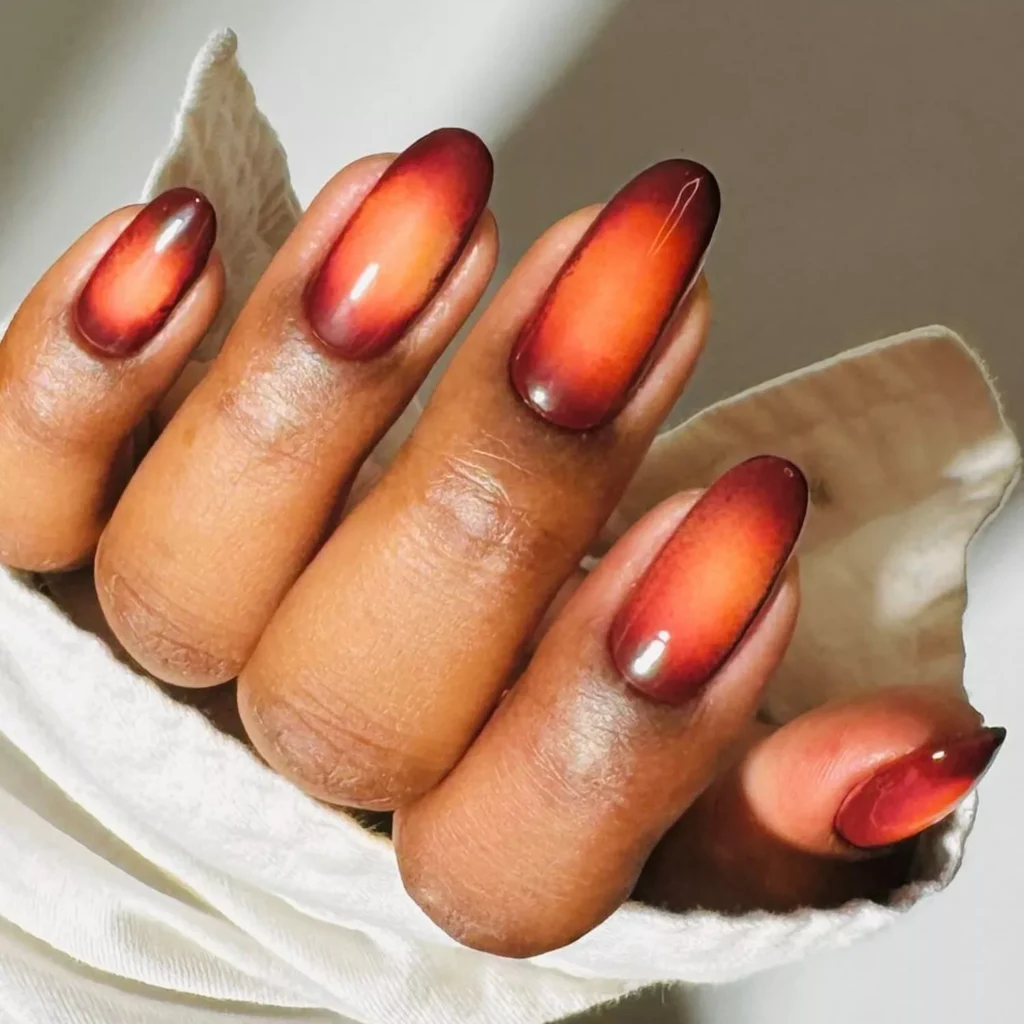
Autumn Ember Aura Nails center the design around a diffused glow that gradually deepens toward its surrounding edges. Concentrated color near the middle gives each nail a softly illuminated focal point, while the blurred transition keeps the aura free from hard boundaries. Subtle tonal movement makes the center appear almost suspended beneath the surface. Carefully controlled diffusion preserves the rounded, atmospheric quality that defines an aura effect.
3. Autumn Mismatched Nails
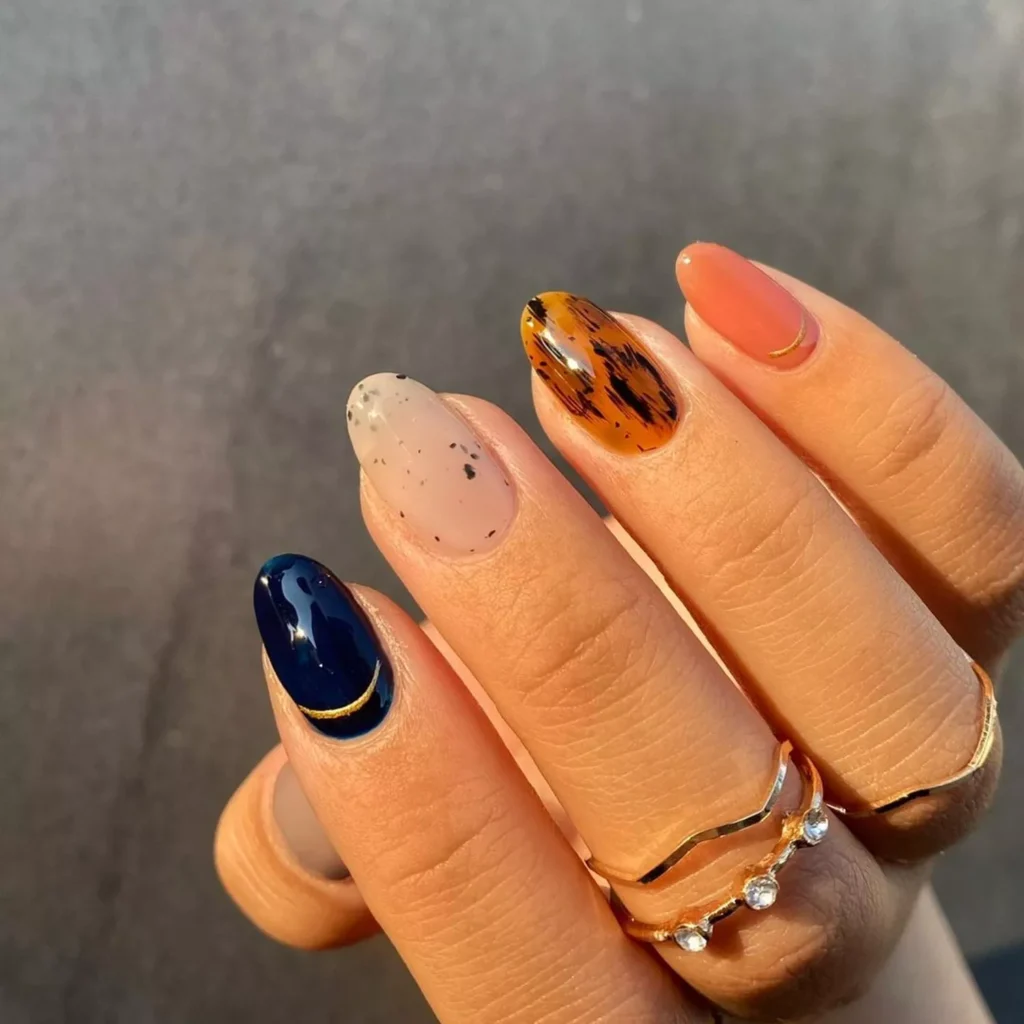
Autumn Mismatched Nails give every nail permission to carry a different piece of the overall composition. Varied artwork, spacing, and pattern placement keep the manicure from settling into a repeated sequence. One nail can hold a small detail while another carries a fuller visual element, creating contrast through variation alone. Uneven distribution makes the set feel assembled rather than duplicated.
4. Burgundy Floral Ghost Nails
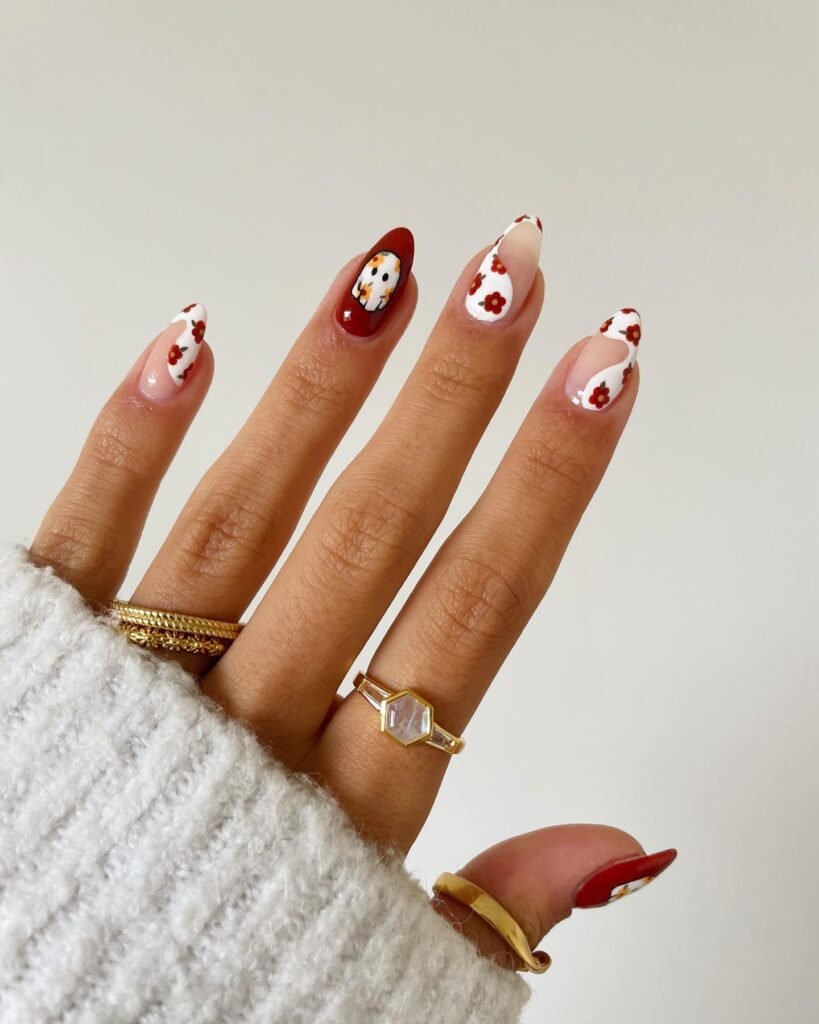
Burgundy Floral Ghost Nails pair burgundy floral imagery with a faint, ghostlike treatment that keeps the artwork delicate. Petals can appear partially faded, allowing portions of the underlying surface to remain visible around each flower. Curving stems and fine floral marks provide structure without filling the entire nail. Soft transparency gives the blossoms a layered quality, as though the artwork sits lightly beneath the surface.
5. Java Ombre Swirl Nails
Java Ombre Swirl Nails use flowing swirls to connect gradually shifting Java tones across the nail. Curved bands can travel in different directions, giving the surface a sense of movement rather than a static color block. Ombre transitions soften the spaces between neighboring tones and prevent the swirls from appearing sharply segmented. Rounded contours keep the composition fluid from one edge to the other.
6. Chocolate Argyle Almond Nails
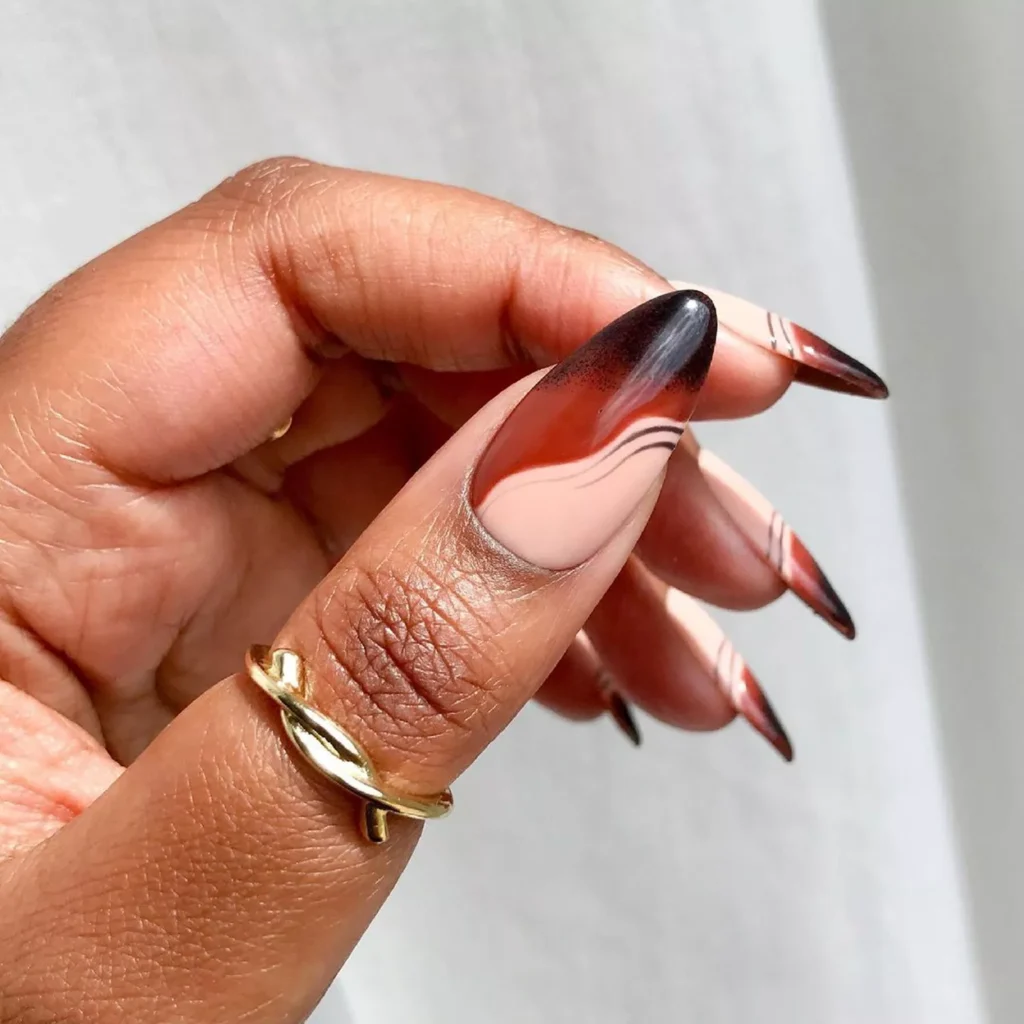
Chocolate Argyle Almond Nails arrange chocolate tones into the recognizable diamond geometry of an argyle pattern. Intersecting lines divide the surface into orderly sections, while alternating diamonds establish a measured visual rhythm. Small linear details can emphasize the crossing points without overwhelming the larger shapes. Repeated geometry gives the manicure a tailored structure that remains clearly visible across each nail.
7. Metallic Bronze Almond Nails
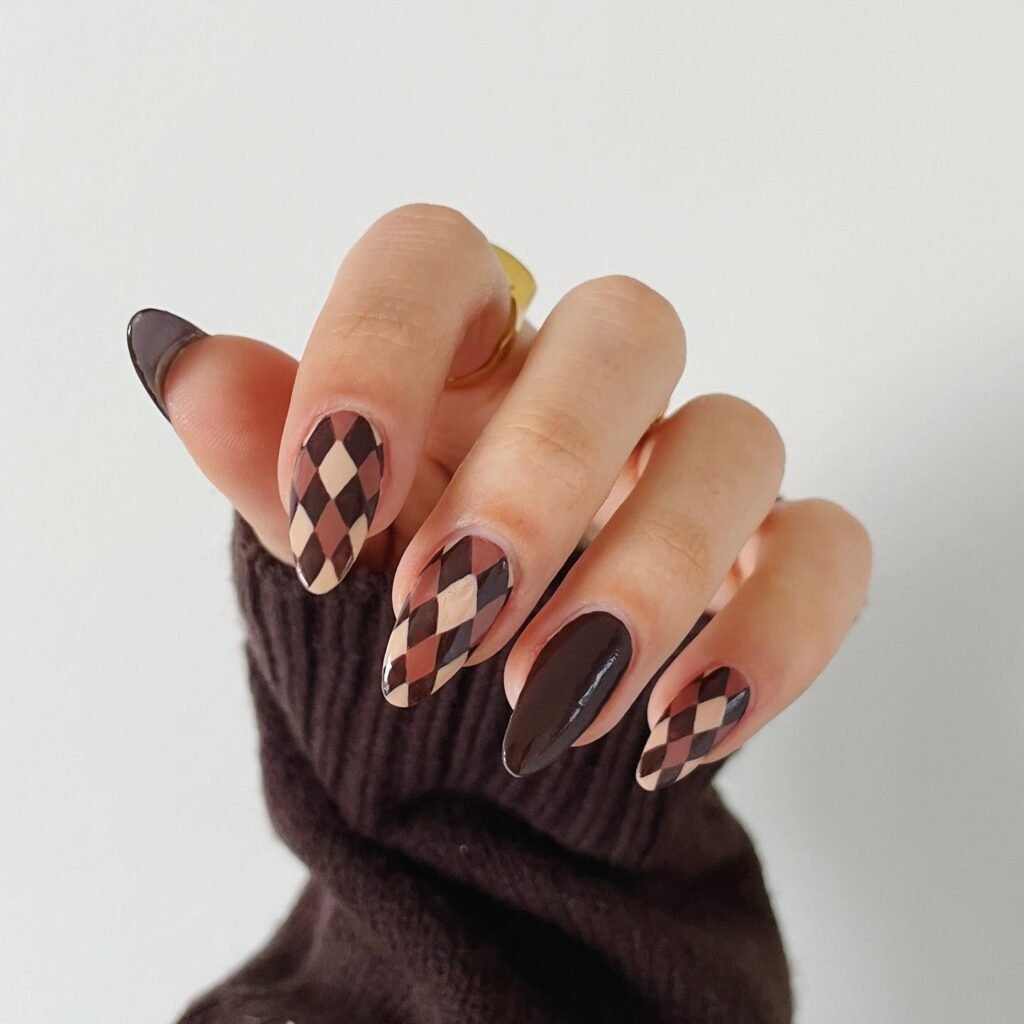
Metallic Bronze Almond Nails rely on reflective bronze surfaces to give the manicure its defining visual character. Light moves across the metallic pigment differently from one angle to another, revealing subtle shifts in intensity. Smooth coverage keeps the reflective quality uninterrupted, while even edges make the bronze appear deliberately placed. Fine changes in light provide much of the dimension without requiring additional artwork.
8. Dark Chocolate Swirl Nails
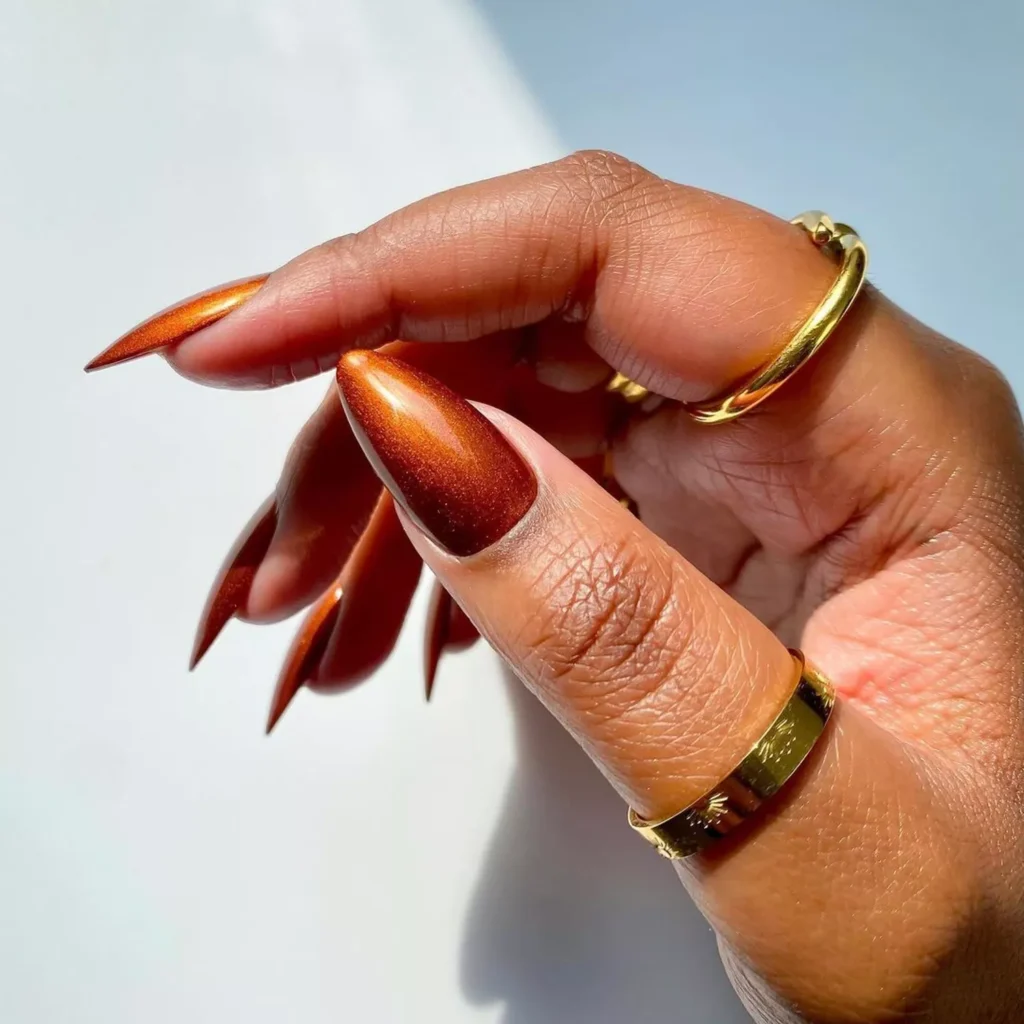
Dark Chocolate Swirl Nails turn curved lines into the main source of movement across the manicure. Deep chocolate tones can wind around one another in elongated paths, producing sections that feel layered without becoming visually crowded. Rounded intersections soften the transitions between each sweeping shape. Varied curve widths keep the pattern from appearing mechanically repeated from nail to nail.
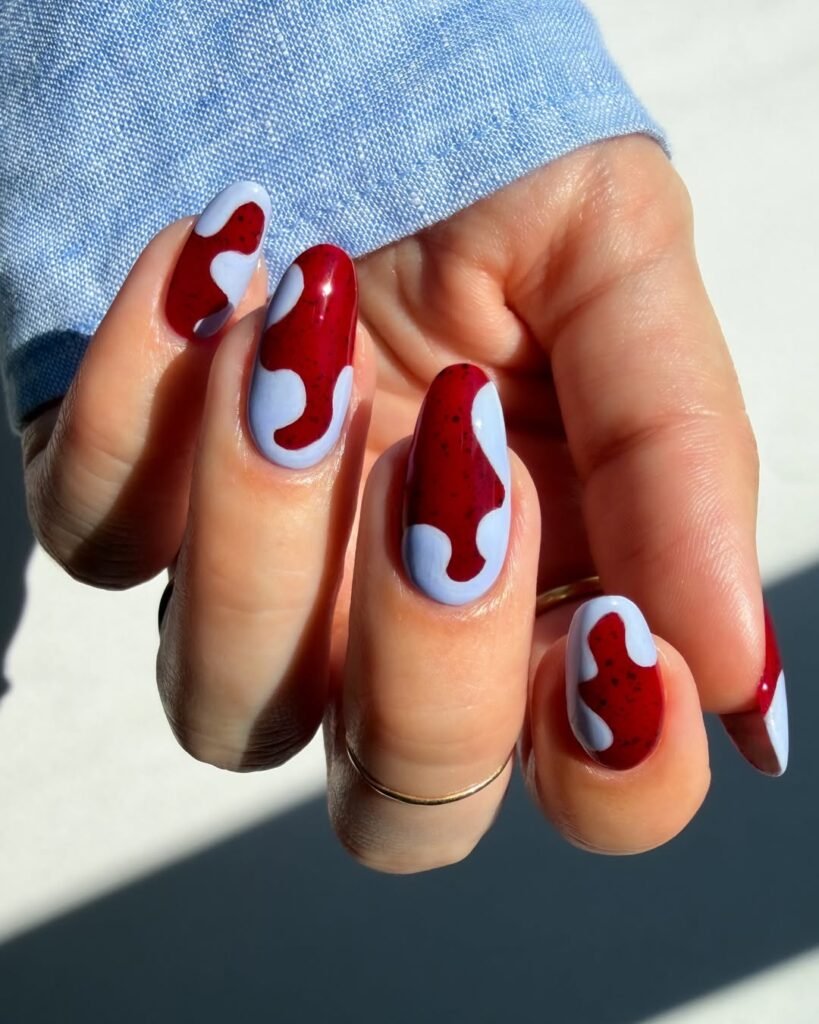
9. Minimalist Camo Nails
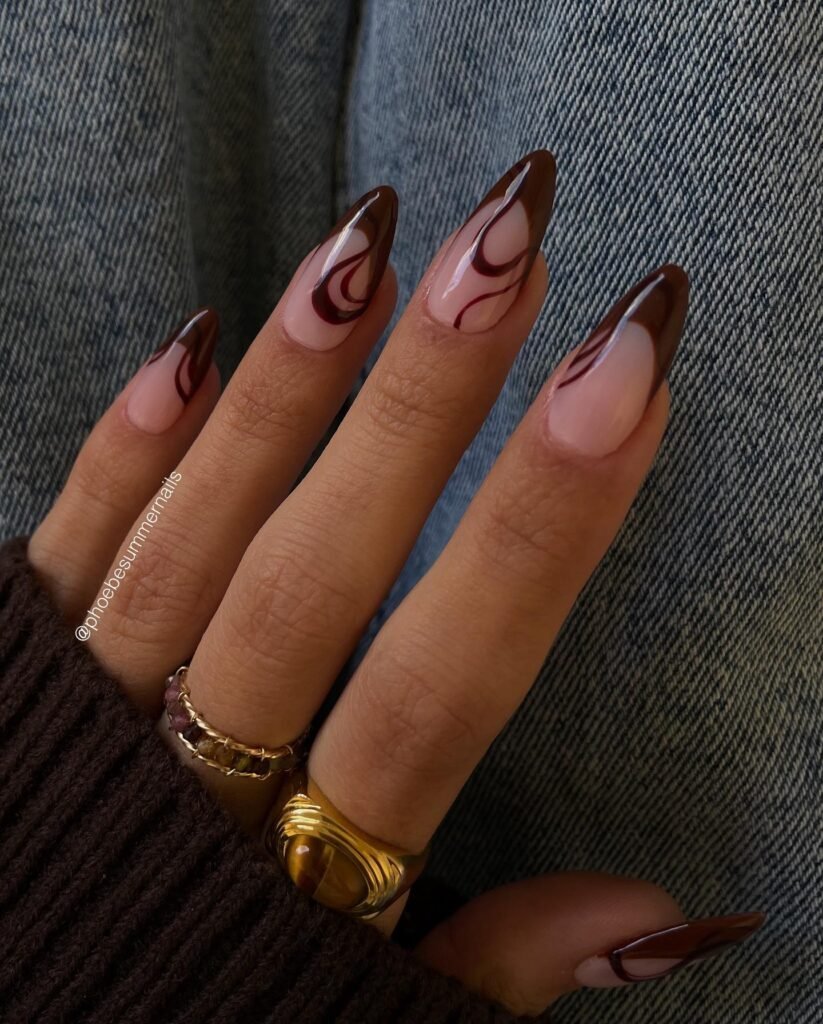
Minimalist Camo Nails reduce camouflage-inspired artwork into smaller, cleaner patches rather than dense overlapping shapes. Irregular sections can sit apart from one another, leaving visible negative space between the individual forms. Controlled edges give each patch a distinct silhouette while preserving the recognizable camo effect. Sparse placement keeps the composition focused on shape and spacing instead of visual clutter.
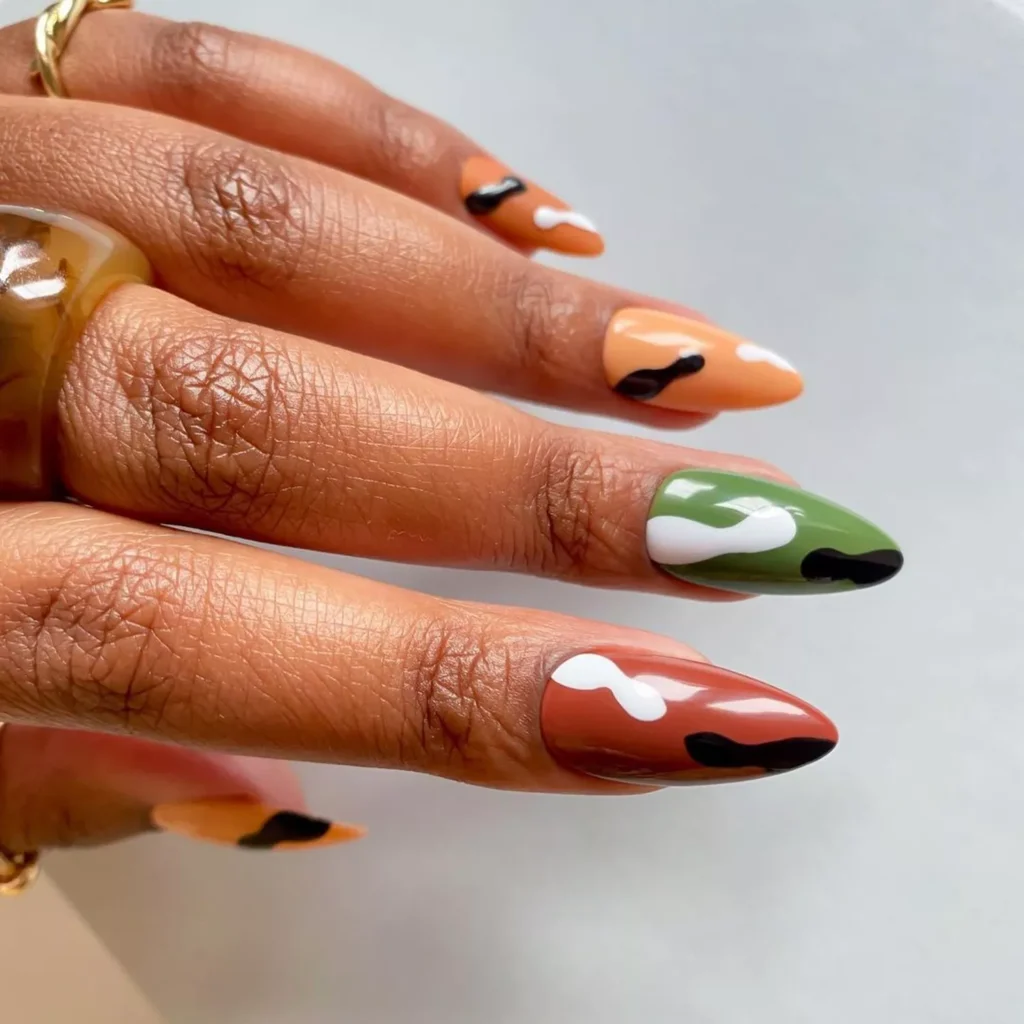
10. Groovy Negative Space Nails
Groovy Negative Space Nails use sweeping curved lines to divide the nail while intentionally leaving portions of the surface untouched. Arcing shapes can bend around one another, producing a playful sense of motion through their changing direction. Open gaps interrupt the artwork and keep the composition from becoming solid across the entire nail. Uneven curves add personality, while clean spacing keeps each line visually legible.
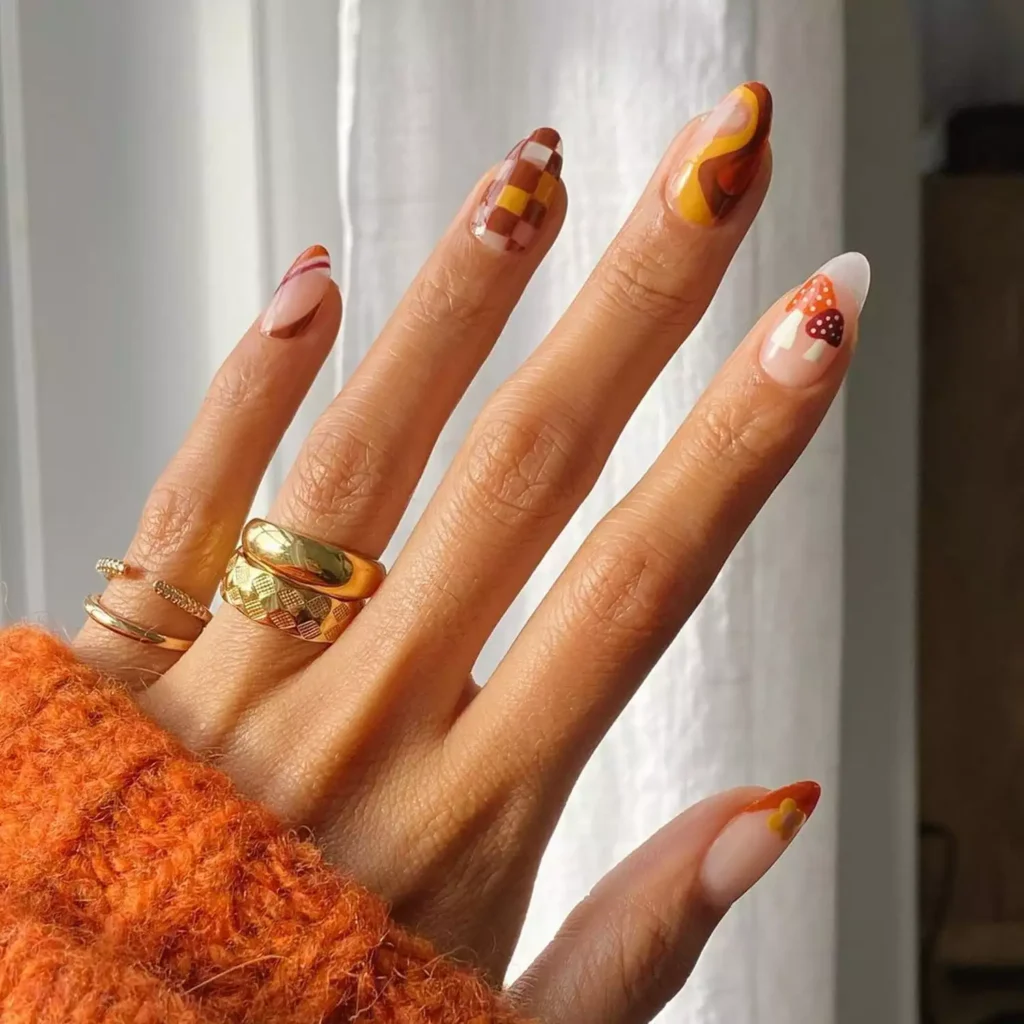
11. Matte Black Art Deco Nails
Matte Black Art Deco Nails translate geometric Art Deco structure into a muted black surface. Crisp angular lines can frame sections of the nail, with symmetrical shapes giving the artwork its architectural quality. Repeated geometry provides order without requiring a dense pattern across every section. The matte treatment absorbs light across the surface, allowing the precise linework to remain the main visual detail.
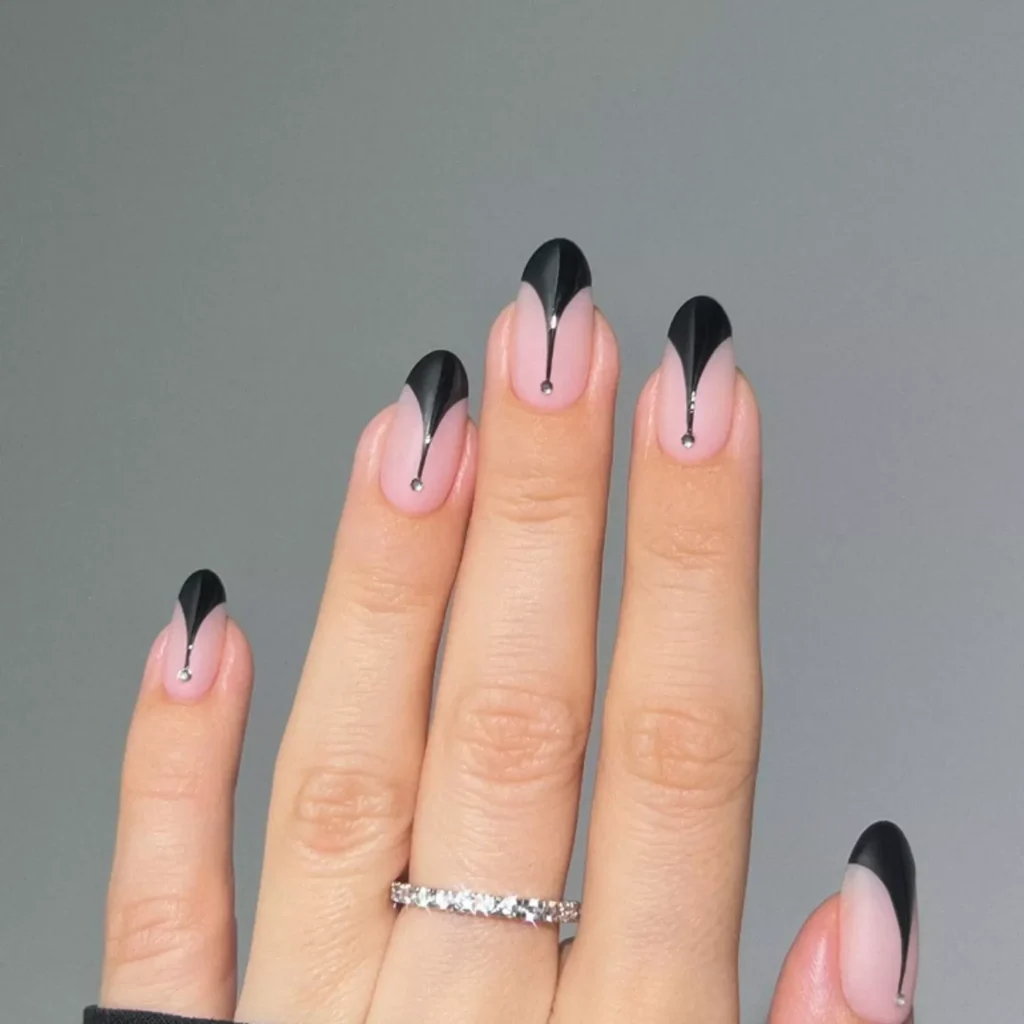
12. Two-Tone Chocolate French Tips
Two-Tone Chocolate French Tips divide the French-tip area into two distinct chocolate sections rather than relying on one continuous band. Curved edges follow the tip cleanly, while the color division introduces a second layer of visual interest. Placement can remain symmetrical so the two tones read as a single connected shape. Negative space beneath the tips keeps the composition from feeling overly dense.
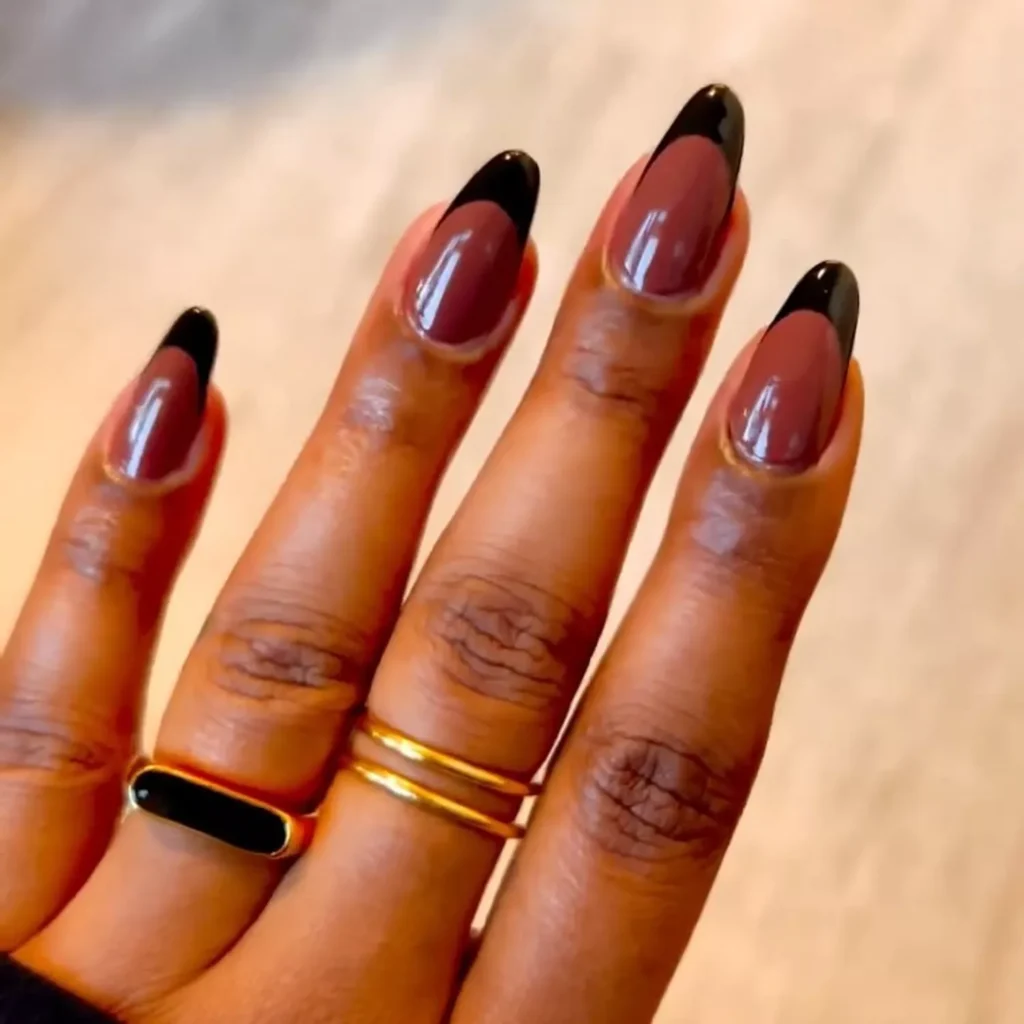
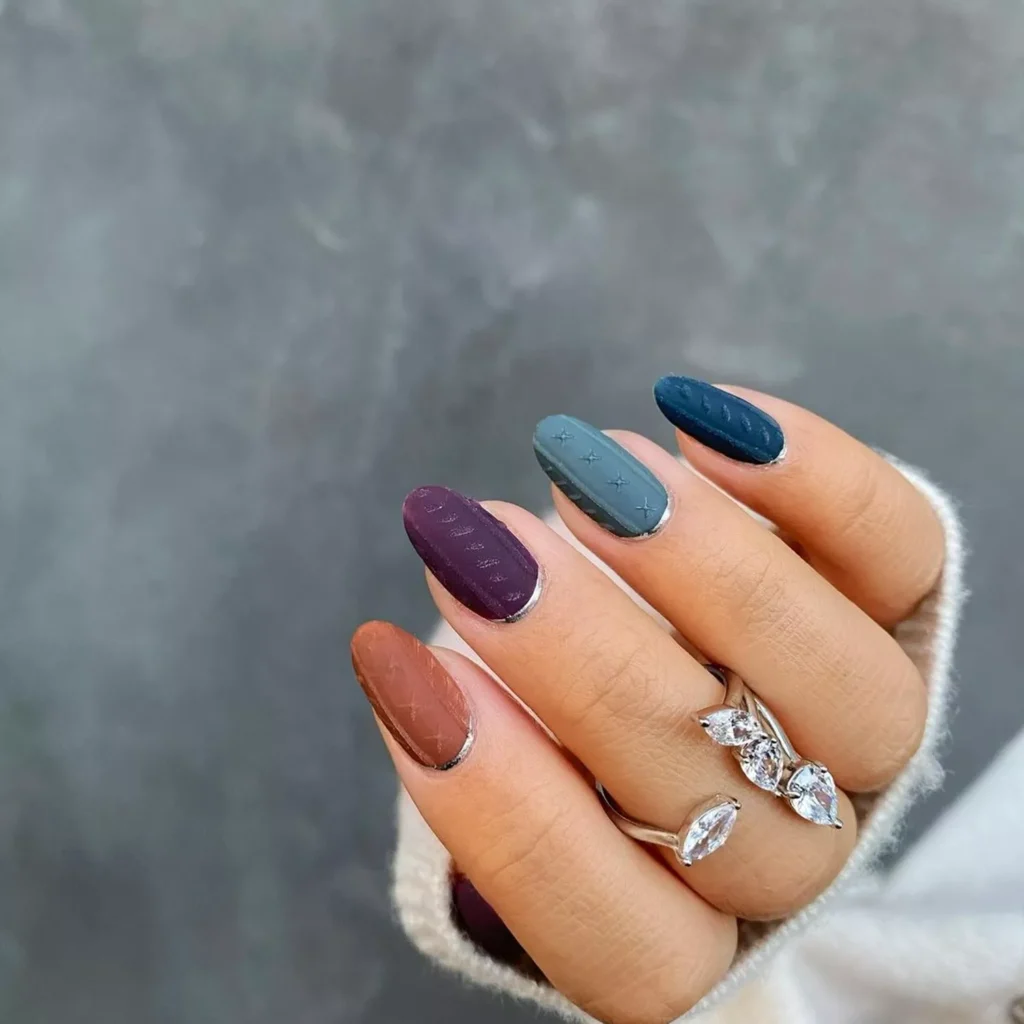
13. Matte Skittle Sweater Nails
Matte Skittle Sweater Nails bring different sweater-inspired textures to individual nails while keeping the entire set under a matte surface. Ribbed lines, woven marks, and raised-looking motifs can vary from one nail to the next, giving each finger its own tactile pattern. Distinct color placement reinforces the skittle concept without requiring identical artwork. Muted light reflection allows the texture itself to command attention.
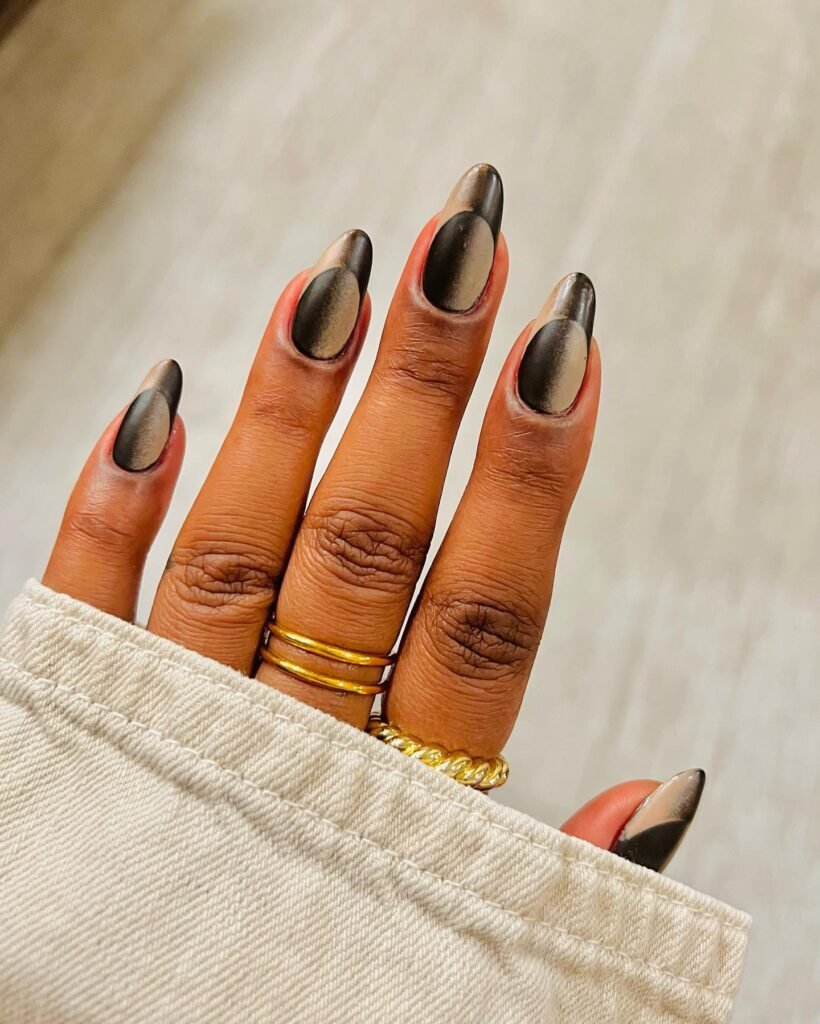
14. Neutral Reciprocal French Tips
Neutral Reciprocal French Tips reinterpret the French shape by placing complementary curved sections opposite one another. Two neutral areas can meet across the nail in a mirrored arrangement, creating a sense of visual exchange rather than a standard tip. Precise curves help the opposing shapes feel connected despite occupying different areas. Open space between the sections keeps the composition light and clearly defined.
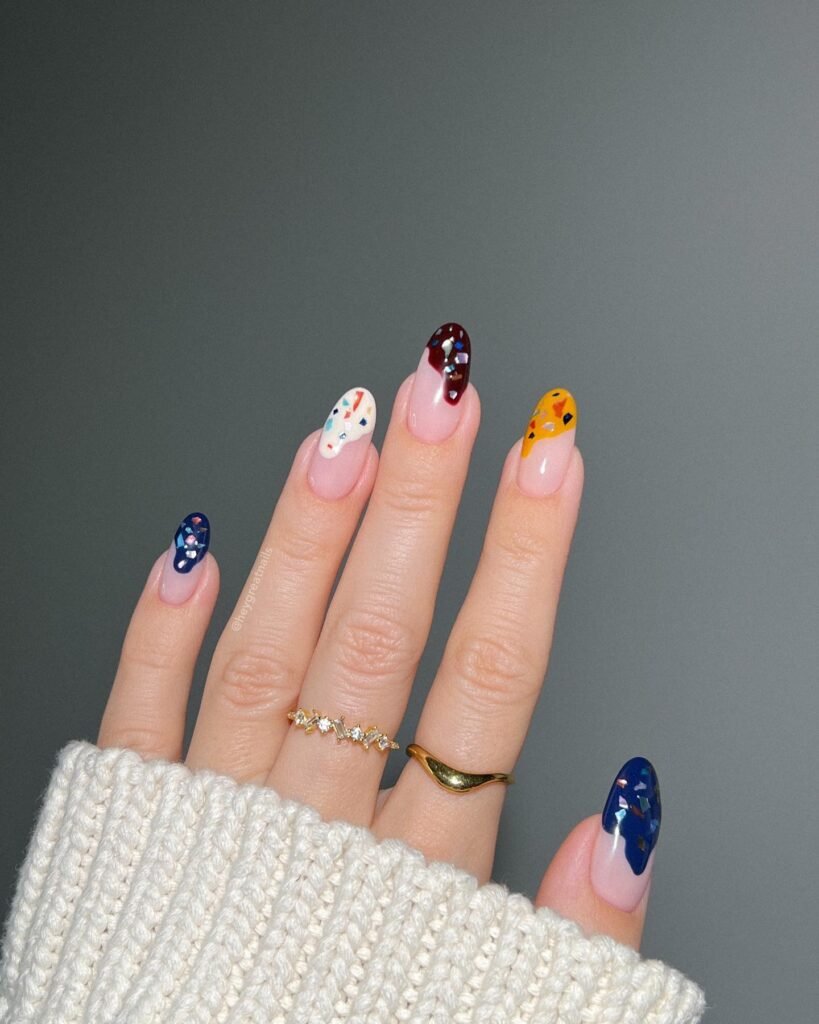
15. Mix-n-Match Autumn Terrazzo Nails
Mix-n-Match Autumn Terrazzo Nails scatter irregular terrazzo fragments across different nail compositions, with each surface carrying its own arrangement. Small pieces can vary in size and direction, preventing the pattern from becoming too uniform. Some nails may hold concentrated clusters while others leave larger spaces between fragments. Layered placement gives the manicure a collected, mosaic-like quality without relying on identical layouts.
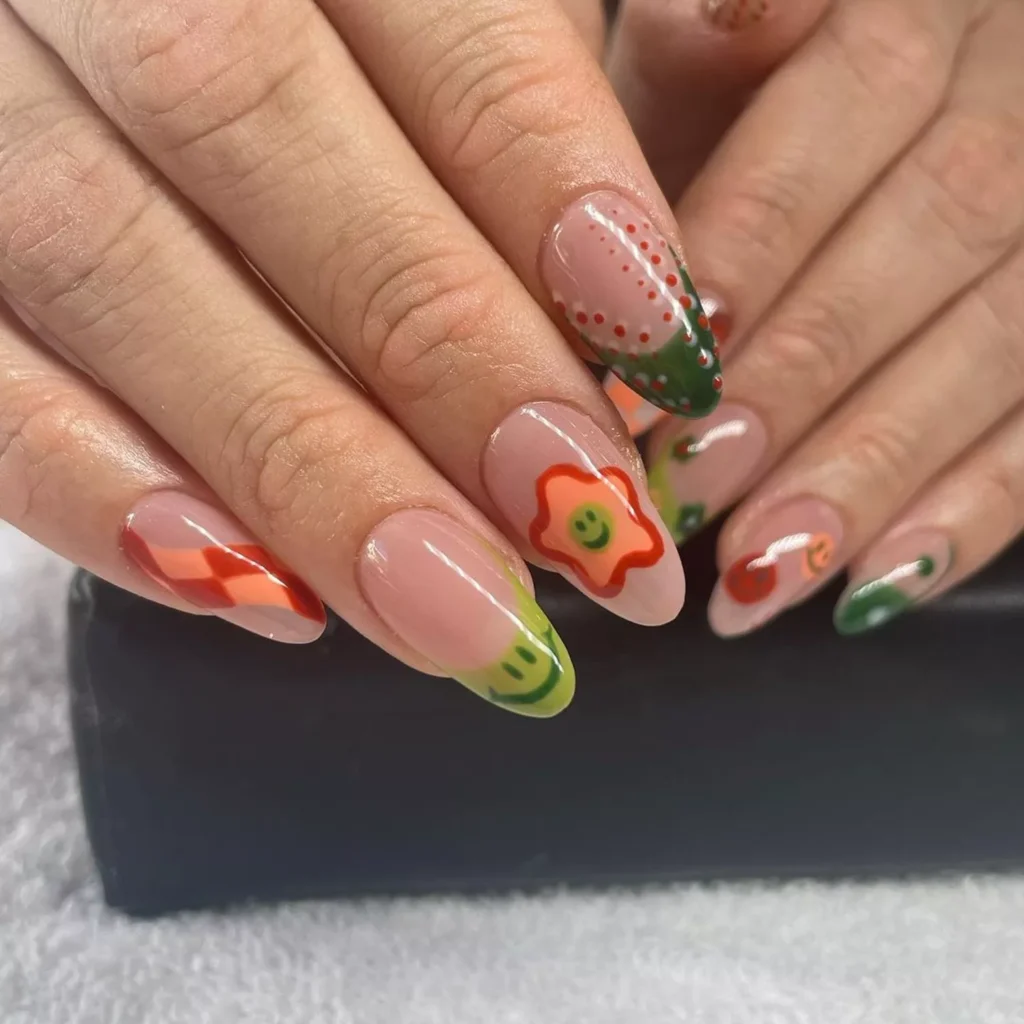
16. Pastel Autumn Mismatch Nails
Pastel Autumn Mismatch Nails bring contrasting soft-toned designs together through varied artwork and placement. Individual nails can shift between simple markings, abstract sections, and small decorative details while retaining the pastel autumn theme. Unequal amounts of artwork create visual pauses throughout the set. Delicate color relationships keep the mismatched elements connected even when their patterns differ considerably.
17. Pumpkin Spice French Tips
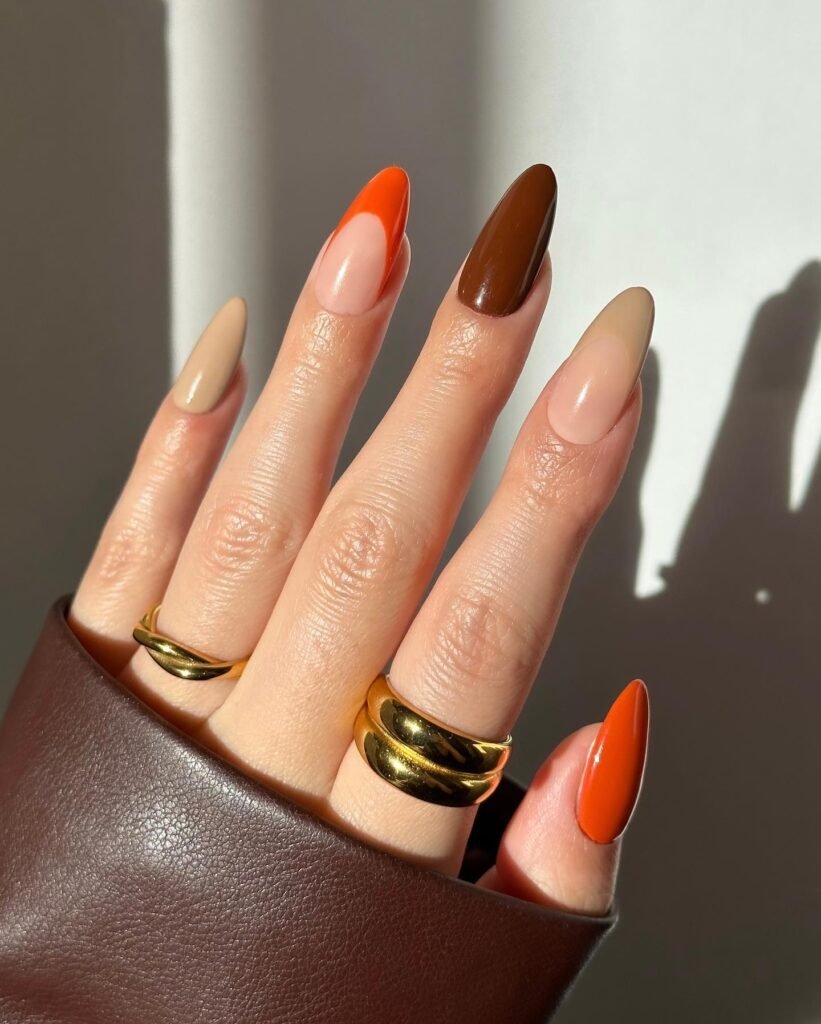
Pumpkin Spice French Tips reinterpret the classic French shape through a pumpkin-spice-inspired tip treatment. Curved color placement follows the free edge while leaving the main body of the nail visually open. Consistent tip contours provide repetition, yet subtle differences in thickness can keep the set from feeling overly rigid. Clean borders make the transition between the base and decorative tip easy to see.
18. Maple Leaf Vein Nails
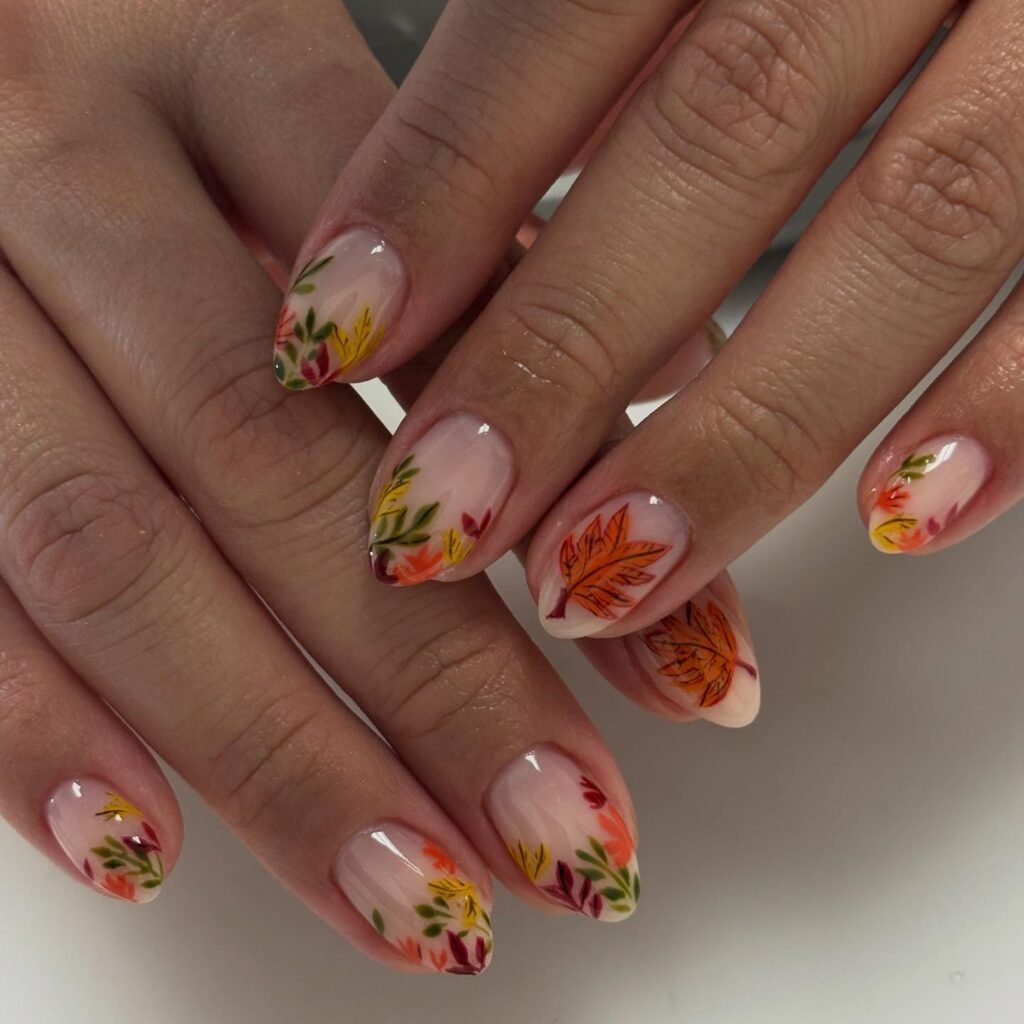
Maple Leaf Vein Nails focus on the fine internal lines that give a maple leaf its recognizable structure. Delicate veins branch outward from a central line, creating an intricate network without requiring a fully filled leaf silhouette. Strategic spacing allows each vein to remain distinct rather than merging into a dark shape. Tiny branching details supply the visual interest, with the central structure acting as the anchor.
19. Tortoiseshell Tip Nails
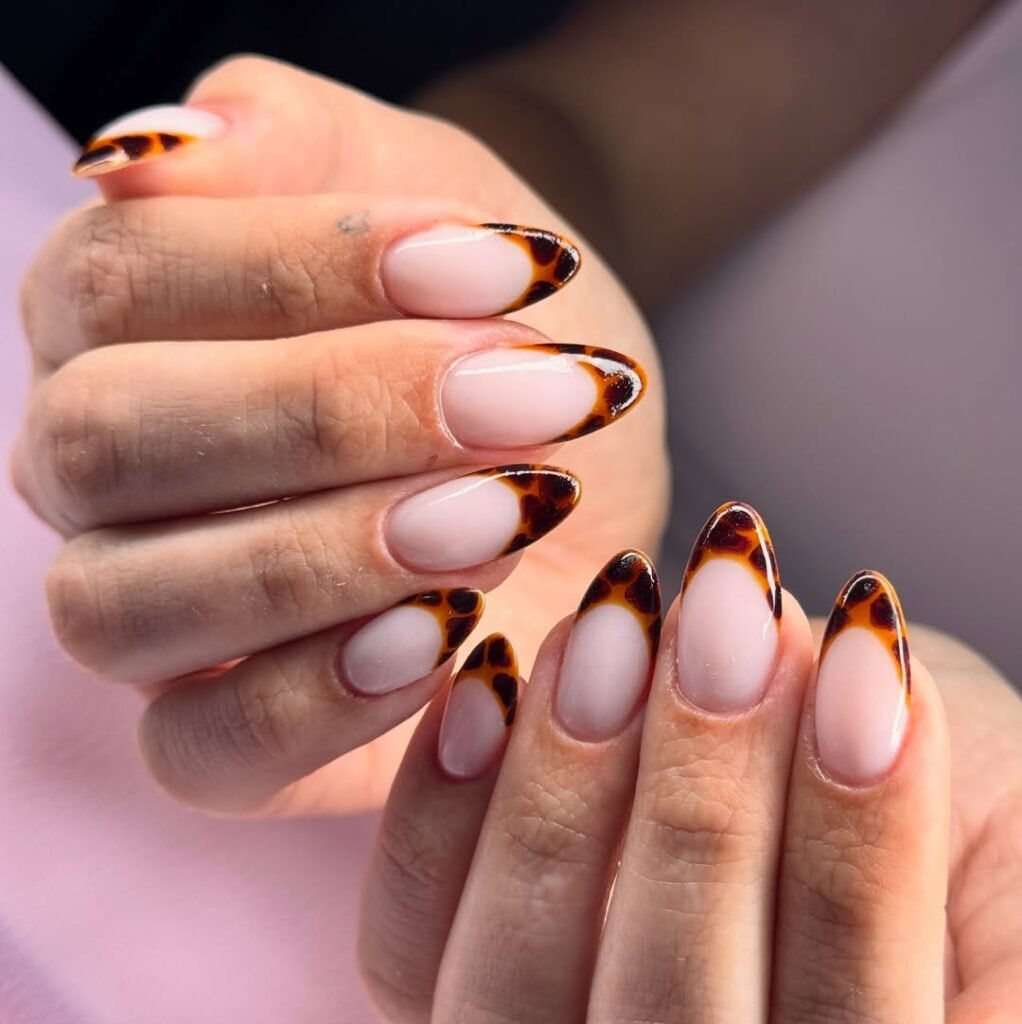
Tortoiseshell Tip Nails concentrate the mottled tortoiseshell pattern along the tips rather than covering the entire nail. Irregular patches overlap within the curved tip area, producing depth through uneven shapes and tonal variation. Rounded borders help the patterned section follow the natural arc of the tip. Keeping the artwork contained creates a clear visual division between the detailed edge and the quieter nail surface.
20. Cinnamon Plaid Accent Nails
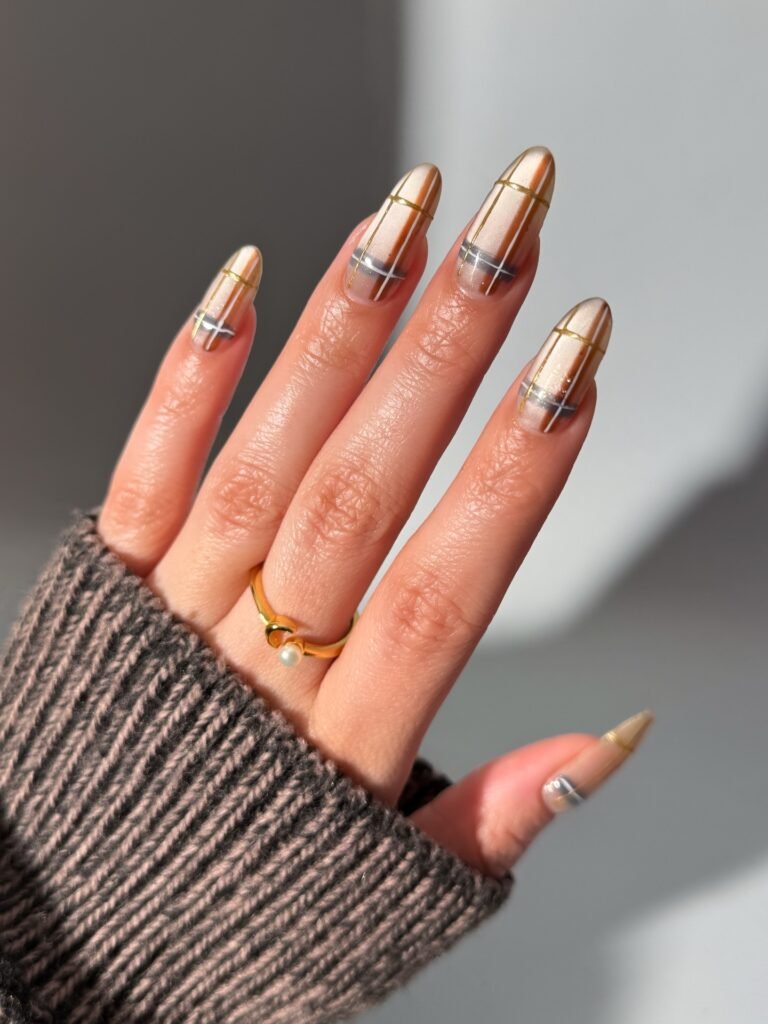
Cinnamon Plaid Accent Nails use intersecting lines to build a plaid pattern around selected accent nails. Horizontal and vertical bands cross at measured intervals, forming small woven sections that become denser where the lines overlap. Varied line widths can add hierarchy without disturbing the underlying grid. Restricting the plaid to accent nails gives the pattern a defined role within the manicure.
21. Burnt Sienna French Nails
Burnt Sienna French Nails place burnt sienna along the curved French tip, giving the manicure a clear color boundary. Smooth arcs follow the outer edge while the open area beneath keeps the composition visually separated. Consistent placement makes the tips read as a unified set rather than isolated marks. Subtle differences in curve depth can add natural variation without disrupting the recognizable French structure.
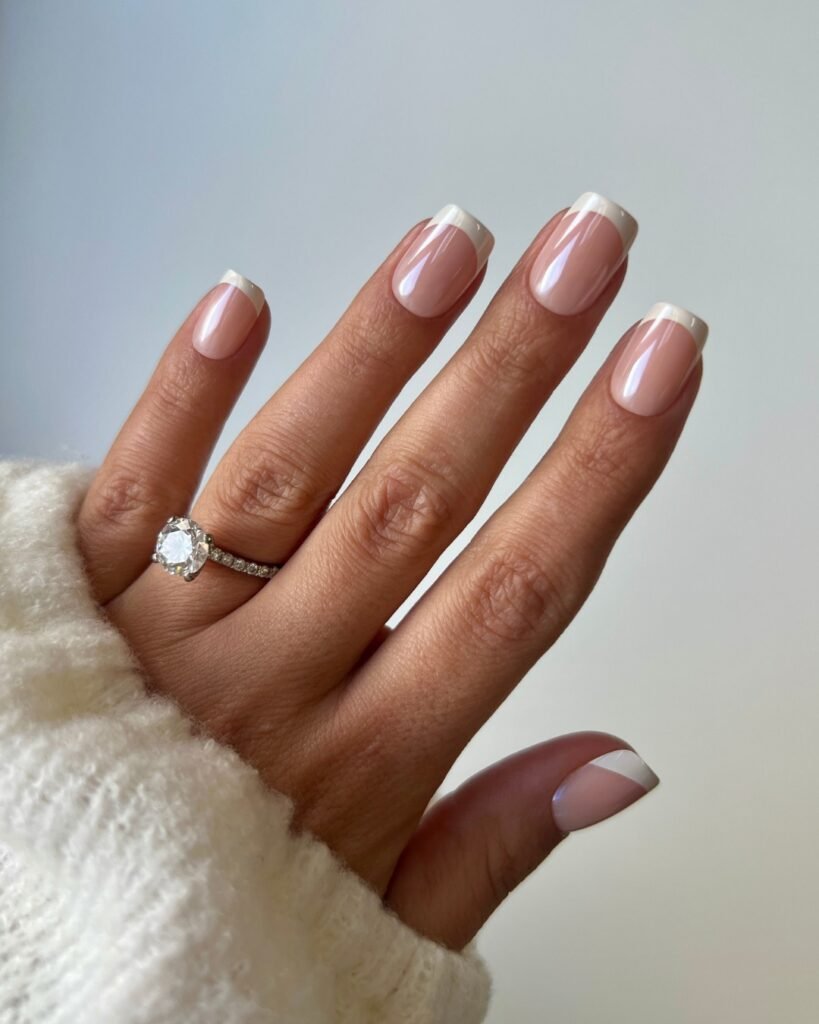
22. Autumn Leaf Outline Nails
Autumn Leaf Outline Nails draw attention to leaf silhouettes through fine contour lines rather than filled shapes. Delicate edges trace the outer points and curves, allowing the interior space to remain open. Small veins can branch from the center to clarify the leaf form without adding visual weight. Minimal linework keeps the artwork airy while preserving enough structure for the botanical motif to read immediately.
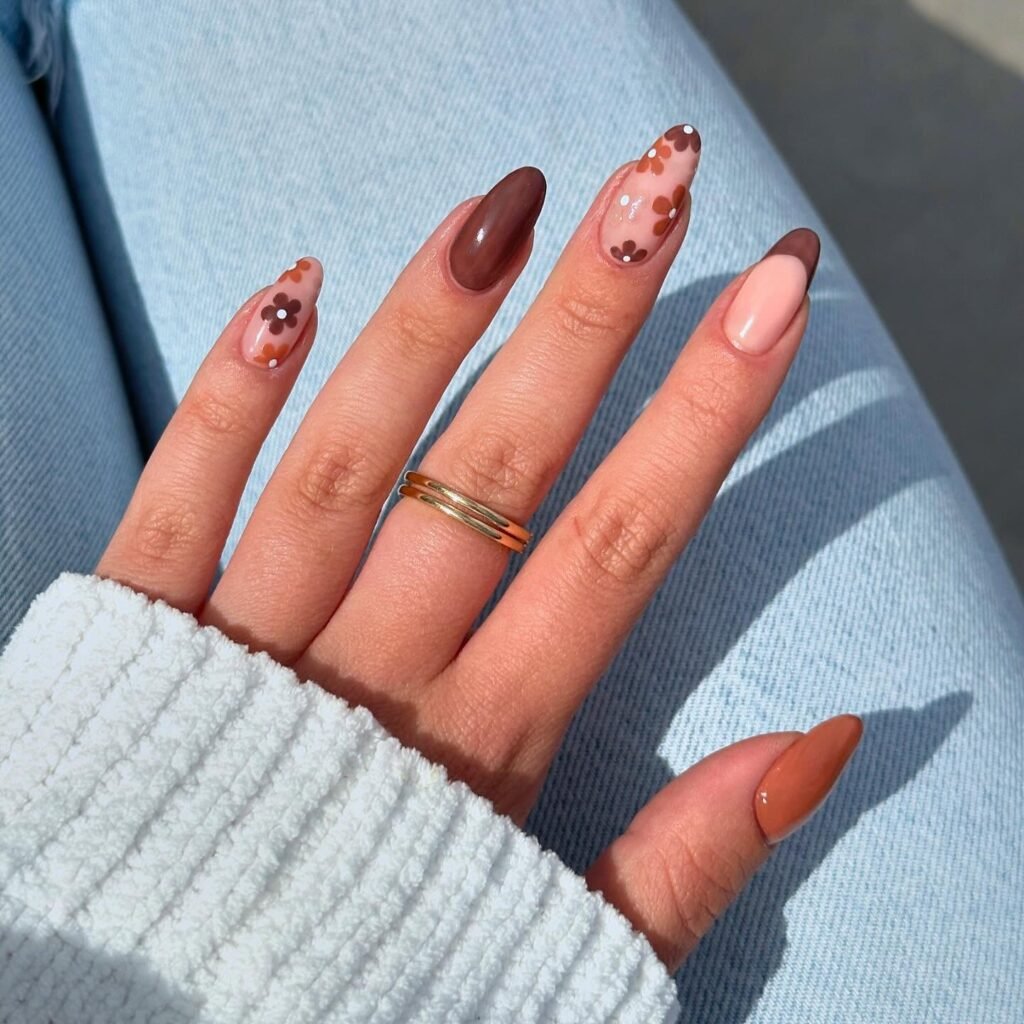
23. Mocha Chrome Accent Nails
Mocha Chrome Accent Nails use chrome treatment selectively, allowing the reflective surface to act as a focused accent within the manicure. Concentrated placement gives certain nails more visual intensity while leaving surrounding areas quieter. Reflective particles shift with movement, producing dimension that changes under different angles of light. Mocha tones ground the metallic effect so the accent retains a defined color identity.
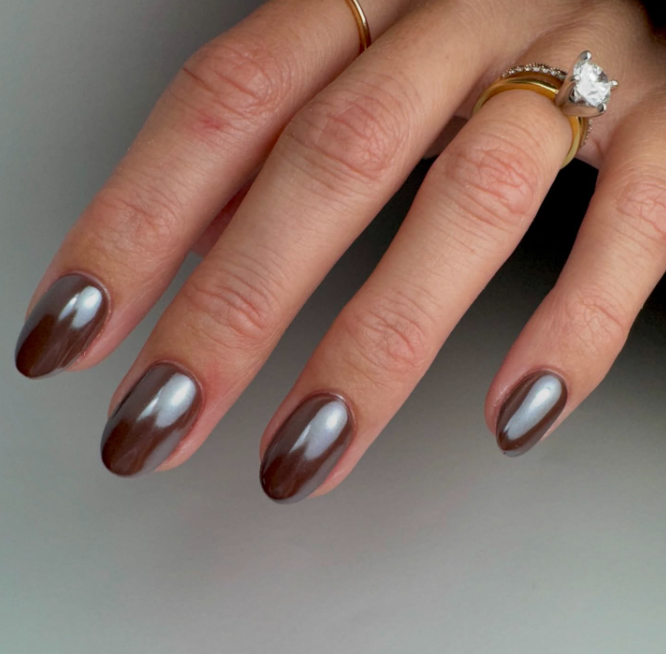
24. Caramel Marble Nails
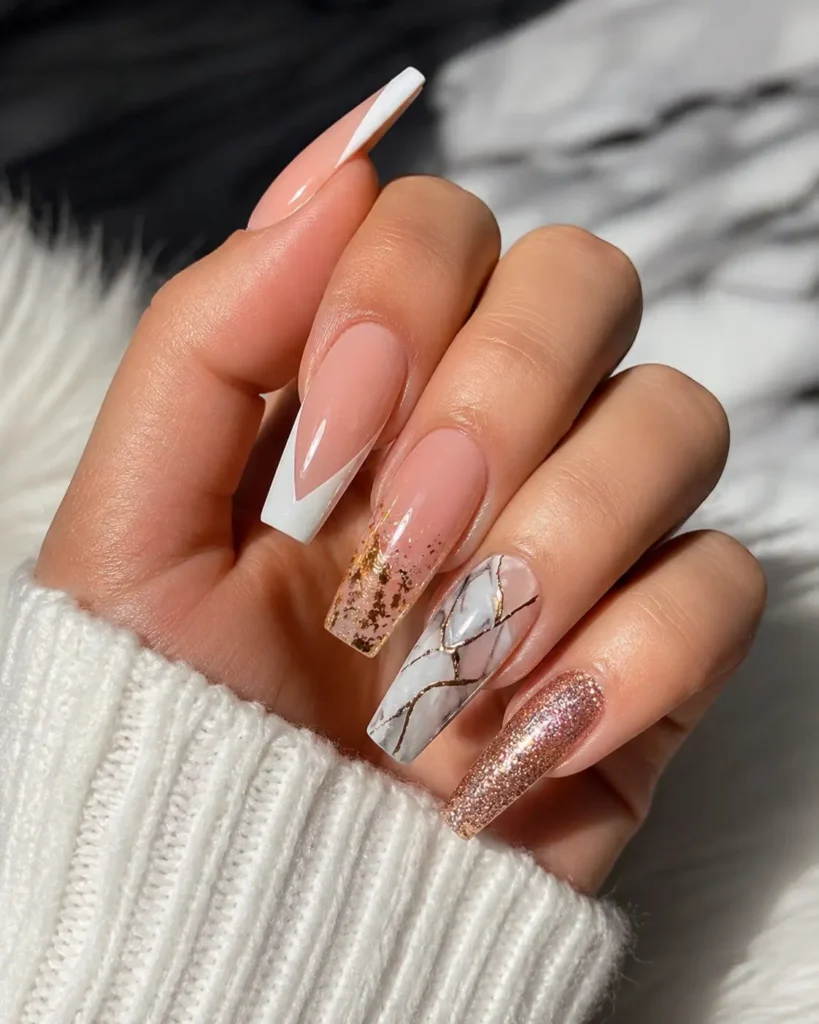
Caramel Marble Nails mimic the irregular movement of marble through winding caramel-toned veining and softened color sections. Fine lines can drift across the nail in unpredictable paths, occasionally widening before tapering into narrower traces. Layered tonal variation prevents the surface from reading as a single block of color. Natural-looking irregularity keeps each nail visually distinct while maintaining the same marble language.
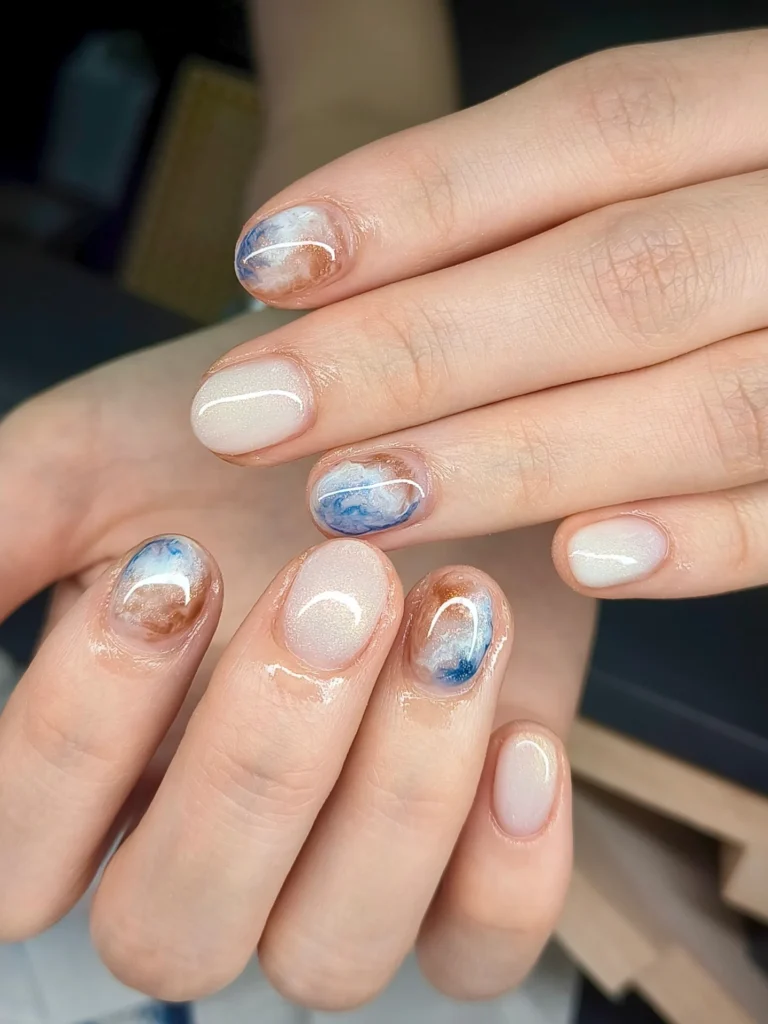
25. Copper Foil Accent Nails
Copper Foil Accent Nails place fragmented foil accents against selected areas rather than distributing metallic detail evenly across every nail. Uneven edges give each piece the irregular character associated with hand-applied foil. Larger fragments can anchor an accent while smaller flecks fill nearby gaps without forming a solid metallic field. Reflective surfaces introduce sharp flashes of light whenever the nail moves.
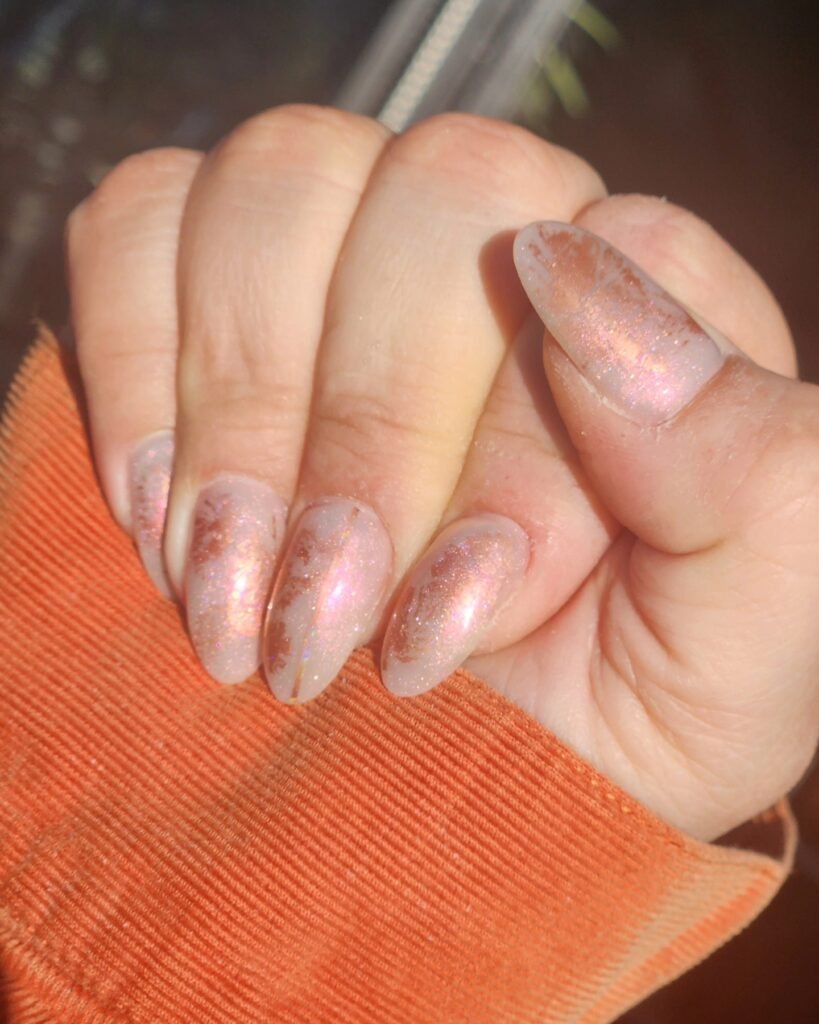
26. Espresso Micro French Nails
Espresso Micro French Nails shrink the French tip into an exceptionally fine line along the nail edge. Narrow espresso bands trace the curve with minimal visual weight, leaving most of the nail surface open. Precision becomes especially important because small changes in line thickness can alter the overall proportion. Repeated arcs connect the nails while preserving the delicate scale of the micro-French design.
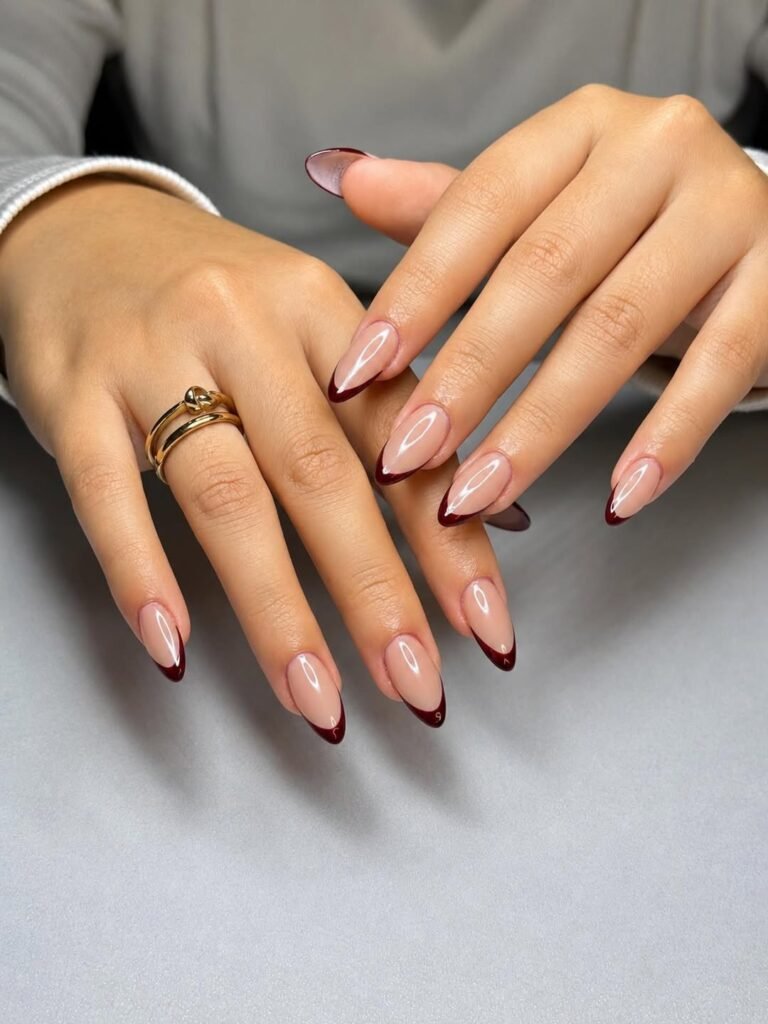
27. Olive Branch Fall Nails
Olive Branch Fall Nails place slender botanical branches across the nail with small leaves extending from the central stems. Curved stems guide the eye through the composition, while individual leaves break up the line without filling the surface. Uneven leaf placement gives the branches a more organic silhouette than evenly spaced motifs. Fine botanical marks keep the artwork detailed without turning it into a dense illustration.
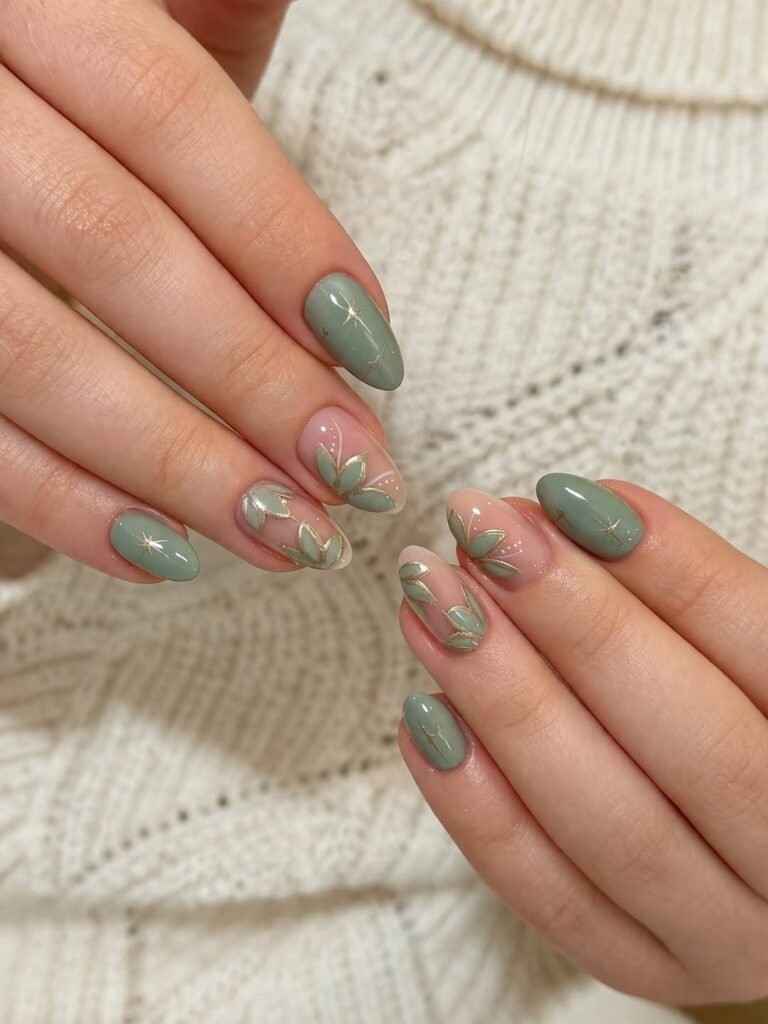
28. Cozy Knit Texture Nails
Cozy Knit Texture Nails translate knitted fabric into raised-looking lines, loops, and interlocking patterns across the nail surface. Braided sections can sit beside ribbed rows, creating noticeable changes in texture from one area to another. Directional lines make the pattern feel woven rather than simply drawn. Layered relief-like details give the manicure dimension that can be appreciated through both sight and implied touch.
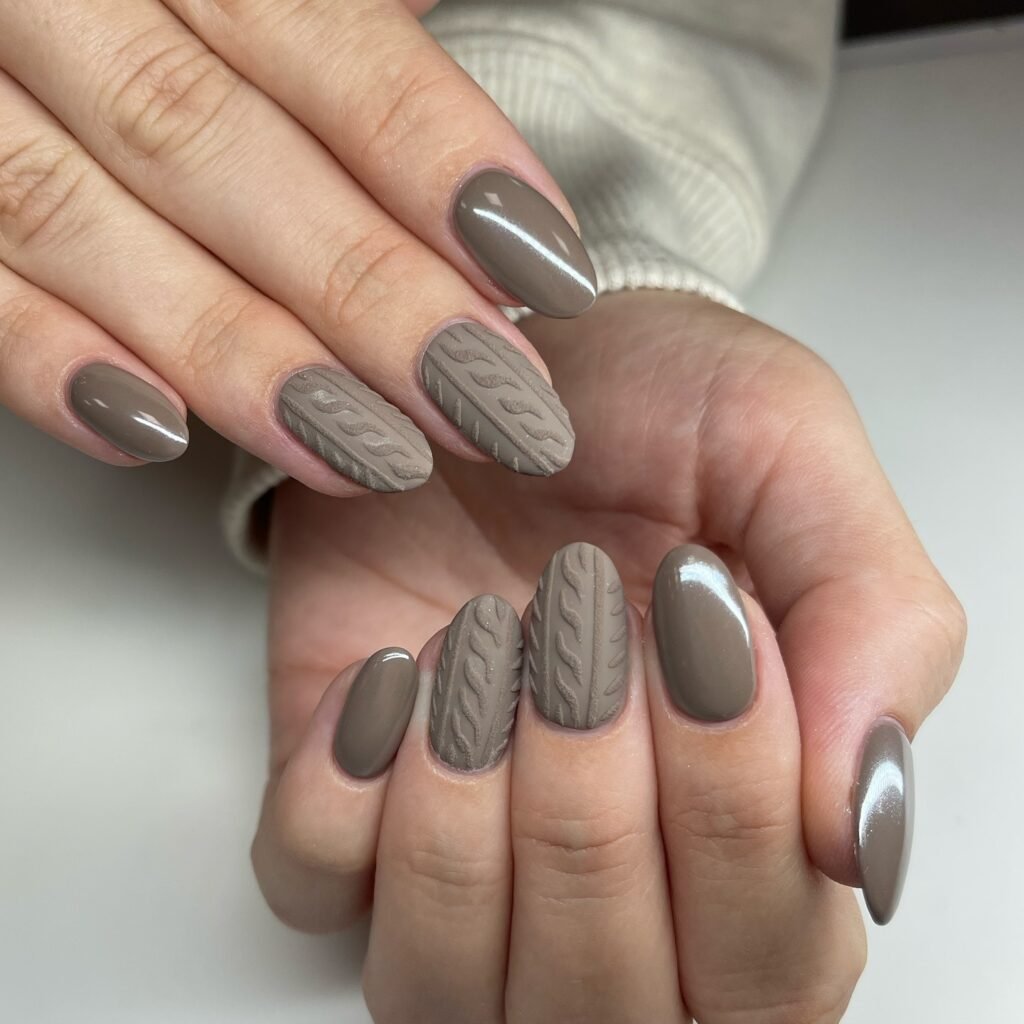
29. Autumn Speckle Nails
Autumn Speckle Nails bring a playful seasonal touch to almond-shaped manicures through scattered flecks that mimic falling leaves and earthy textures. Keep the base soft and understated, then add irregular speckles across each nail for a relaxed, artistic finish. Varying the density prevents the design from looking overly uniform, while a satin or matte surface gives the manicure a refined fall character without making the details feel heavy.
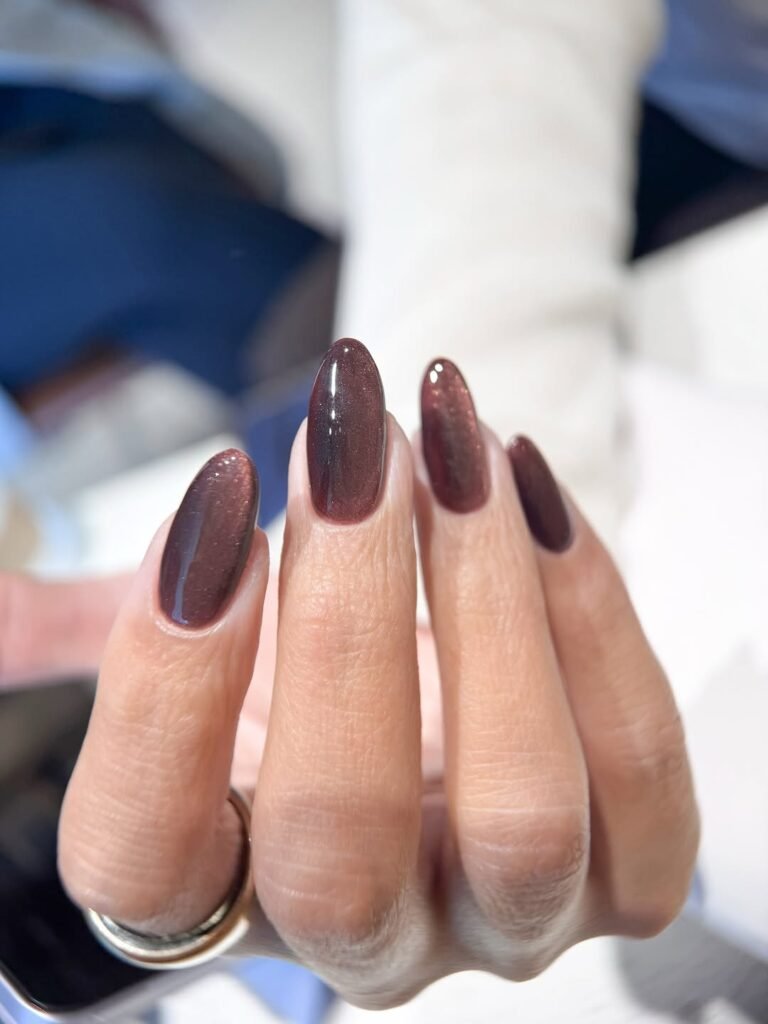
30. Deep Plum Velvet Nails
Deep Plum Velvet Nails center their character on the rich, plush visual quality suggested by velvet. Soft tonal variation across the surface can make the color appear deeper in some areas and lighter in others as light shifts. A velvety texture keeps the surface from reading as completely flat, adding dimension through subtle changes rather than detailed artwork. Concentrated depth gives the manicure a distinctly tactile visual presence.
Conclusion
Manicure can say plenty through one carefully considered detail, whether a fine botanical line, an unexpected texture, or a striking shift in color. Almond Fall Nails become more distinctive when each element has a clear place within the composition instead of competing for attention. Fall almond nail designs can lean intricate or restrained, while autumn almond nails may center on pattern, texture, or a single expressive accent. For fall nail art ideas, personal taste matters more than following a fixed formula. Let the final details feel deliberate, individual, and naturally connected to your own aesthetic.
Pingback: Beautiful Black Halloween Nails With Striking Spooky Details - The Fashion Magazine
Pingback: Rich Red Fall Nails for a Warm and Captivating Autumn Look -